


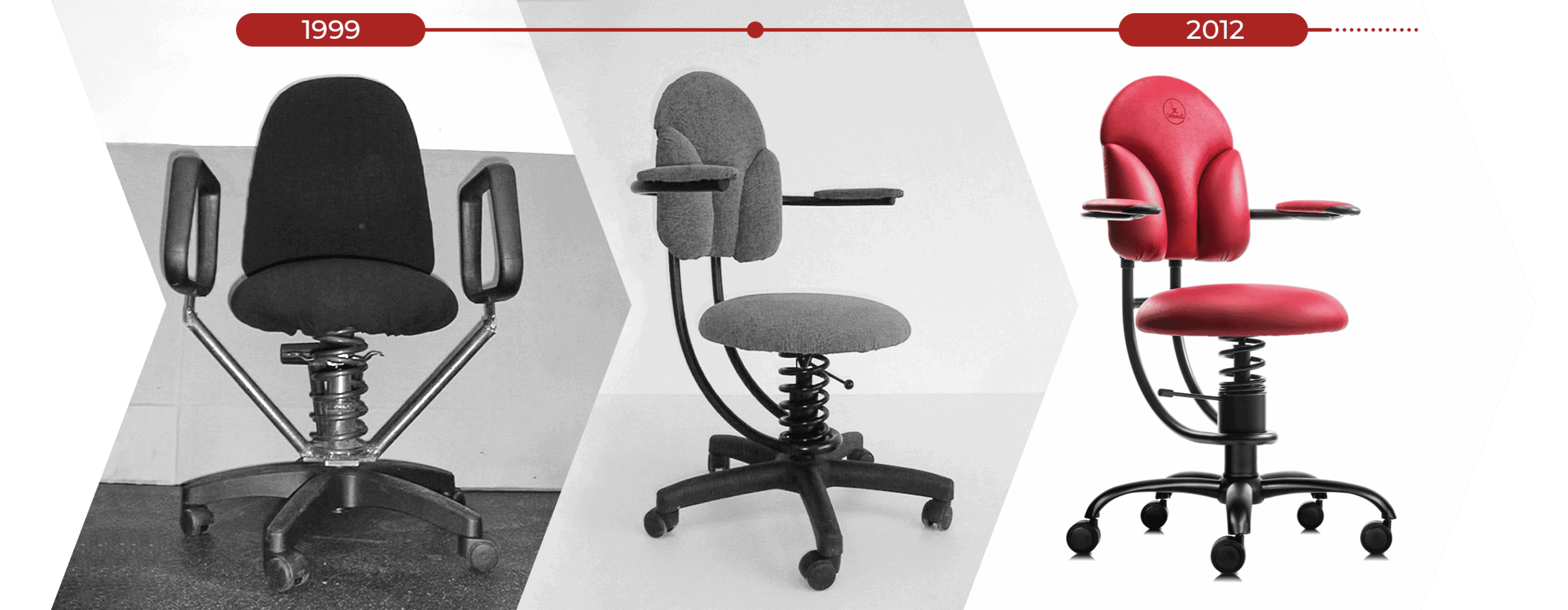
In 1999, I saw several doctors and physiotherapists for low back pain and was advised to sit on an orthopaedic ball while working . I found that, although sitting on it was very useful, it was quite tiring and impractical at work. So, just for my own use , I made a chair that perfectly imitated sitting on a ball, but did not yet resemble a real chair.
When the customers who came to us for the signs also wanted it, I only started thinking about making and marketing it, but before that I had to check what the profession thought of it. I contacted an orthopaedic doctor, prof. dr. sci. Prof. Janko Popovič, dr. med. , who was rather sceptical during our first phone conversation, saying that he gets up to 20 chairs a year for evaluation and that he had not yet recommended any. Rather unconvinced, I went to see him anyway, and when he congratulated me on it, I got my wings and decided to start making them for others.
I presented my patented invention for the first time at the Alpe Adria Dom 2000 trade fair. My girlfriend and I were assembling four chairs by 5 a.m. on the opening day, but it was worth it because the response from the fair visitors was overwhelming. Their enthusiasm has not diminished at other local fairs, such as the furniture fair in Ljubljana and the crafts fair in Celje. Many visitors visit us in the sales and showroom after the fair.
At the Celje Crafts Fair in 2001, we received an order for the 1000th SpinaliS chair, which, through 11 stages of development, has taken the final shape of a modern office chair, and sales are increasing day by day.
The SpinaliS chair’s flexible seat means that there is no passive sitting, which means that the back muscles are constantly tensed and strengthened, reducing the pressure on the intervertebral discs, which has a beneficial effect on the entire spine.
I recommend it to you.
Tomaž Ham